Australian Mining rules the Government.
The Australia I knew is gone. And with it all the industries that made Australia self-sufficient, innovative, productive and a world leader in so many areas.
To break this down I will show where Australia came from and where it is now from a perspective of GPD and employment. These two factors tell you a great deal about how a nations economy and society is structured.
NBER - Australias 1990s Productivity Surge and its Determinants
From the table on page 48:
| Sector | Output Share % of MFP |
|---|---|
| Agriculture | 6 % |
| Mining | 8 % |
| Manufacturing | 22 % |
| Electricity, gas, and water | 5 % |
| Construction | 9 % |
| Wholesale trade | 9 % |
| Retail trade | 9 % |
| Accommodation, cafes, and | |
| restaurants | 3 % |
| Transport and storage | 9 % |
| Communications | 5 % |
| Finance and insurance | 11 % |
| Cultural and recreational | |
| services | 3 % |
Note: MFP - Multifactor Productivity (slightly more complex measurement than GDP)
Take a careful look at these sectors and look how spread they are, and how small mining is, and how large manufacturing is. This is a good and healthy looking economy, looking at this information alone, it was clear this was making Australia a wealthy and, more importantly, a growing regional power in the world.
Australian gov reporting has changed over time to only look at yearly growth rates of MFP which is, I think, intentional so that it is harder to generate the above table. However the data, is available.
ABS - Estimates of Industry Level KLEMS Multifactor Productivity
With a little bit of maths, I have a table that is representative of the source data and shows the current MFP output % share. And this is why this isnt shown any more:
| Industry sector | Share (%) |
|---|---|
| Agriculture | 3–4 % |
| Mining | 12–14 % |
| Manufacturing | 5–7 % |
| Electricity, gas, water & waste | 2–3 % |
| Construction | 7–9 % |
| Wholesale trade | 5–6 % |
| Retail trade | 4–5 % |
| Accommodation & food services | 2–3 % |
| Transport, postal & warehousing | 4–5 % |
| Information media & telecommunications | 2–3 % |
| Financial & insurance services | 8–10 % |
| Arts & recreation services | 1–2 % |
The reason there are ranges is because of how the data is structed in the spreadsheets into growth, labour and capital grow information. However the above is quite accurate and explains the problem well.
What does MFP look like now?
In a single word. Bad.
- Mining has doubled.
- Agriculture has halved (this is almost the opposite from what you hear from the media)
- Manufacturing is now a quarter of what it used to be
- Retail and Wholesale trade have both reduced by up to half.
- Transport and storage has also halved.
This has resulted in a lop-sided Australian economic structure. Now remember, this is mostly related to productivity, not actual monetary value and worth. The numbers here reflect information about how these sectors are performing from a labor and capital expenditure perspective.
Where are people employed?
Jobs and skills Aus - Occupation and Industry Profiles
| Industry | Workforce Share | Median Age |
|---|---|---|
| Agriculture, Forestry and Fishing | 2.0 | 51 |
| Mining | 2.1 | 42 |
| Manufacturing | 5.9 | 43 |
| Electricity, Gas, Water and Waste Services | 1.5 | 41 |
| Construction | 9.3 | 37 |
| Wholesale Trade | 2.2 | 43 |
| Retail Trade | 9.1 | 33 |
| Accommodation and Food Services | 6.5 | 26 |
| Transport, Postal and Warehousing | 5.1 | 43 |
| Information Media and Telecommunications | 1.2 | 38 |
| Financial and Insurance Services | 3.7 | 41 |
| Rental, Hiring and Real Estate Services | 1.5 | 42 |
| Professional, Scientific and Technical Services | 9.5 | 40 |
| Administrative and Support Services | 2.9 | 41 |
| Public Administration and Safety | 6.6 | 42 |
| Education and Training | 8.9 | 42 |
| Health Care and Social Assistance | 16.3 | 40 |
| Arts and Recreation Services | 1.8 | 35 |
| Other Services | 3.9 | 38 |
Another table with a number of surprises.
- Mining, while being the main productive force (money maker for companies) is one of the smallest exployed sectors.
- Healthcare, Social Assistance, Education and Training and Public Administration together are 31.5 of the Australian workforce.
- Retail Trade is 9 % of the workforce, with only 4-5 % MFP.
- Service based industries make up more than 60 % of Australias workforce while representing only 16 % of Australias MFP.
A nation that has a lop-sided service based economy, propped up with a mining based economic source is a nation that is in a large amount of economic trouble.
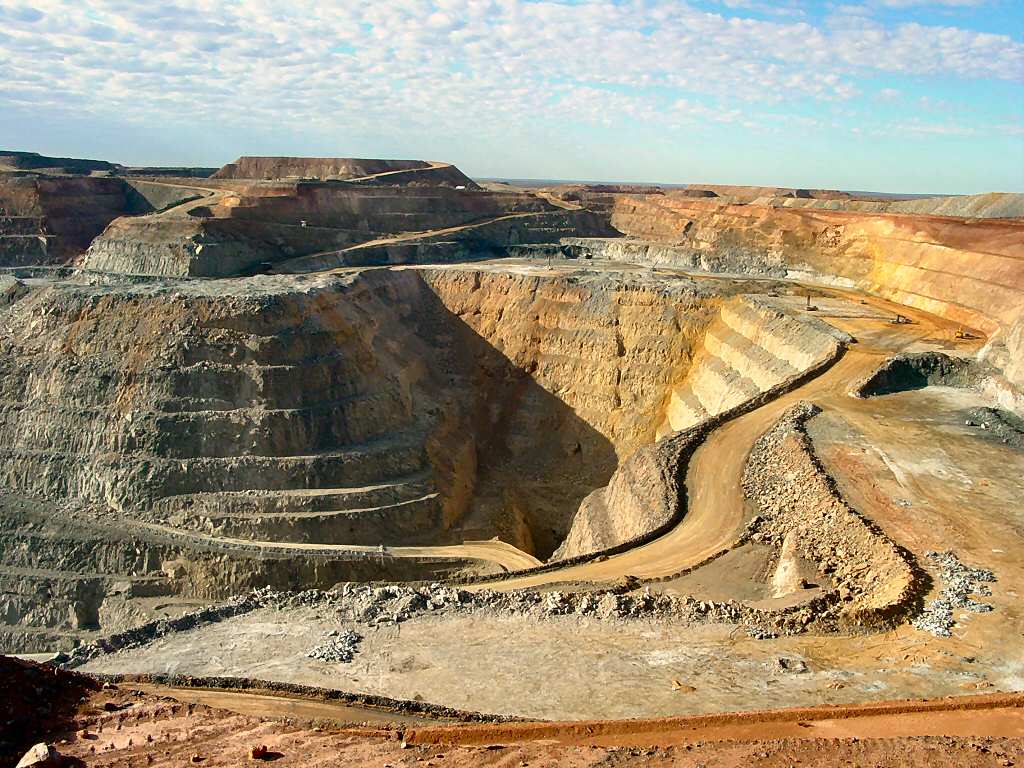
Mining, Mining, Mining.
The result of the heavy mining influence is that a small group of wealthy mining profiteers (some might call Oligarchs in other countries) drive and control the political landscape in the whole country because of this power.
Recent publicity of Australia lacking the governmental control to appropriately tax mining groups has resulted in Australia, one of the largest LNG exporters (next to Qatar), to benefit minimally in comparison to Qatar.
Australia Institute - Government revenue from LNG exports: Australia vs Qatar
“Australia and Qatar are two of the world’s largest exporters of liquefied natural gas, each exporting around 80 million tonnes in 2023, worth $85 billion. From these exports the Qatari Government received $A56 billion, while Australian governments received just $11 billion”
Hard to believe that Australia earns 5x less revenue than Qatar. This is why the mining lobby groups in Australia are so powerful and why changes to this, are very unlikely without serious political upheaval.
Australia Institute - Gas: The facts
The more you delve into other mining sectors like Coal, Steel and similar, these mining areas are predominantly owned by Chinese companies or shell companies run by Chinese companies.
How the Coal sector in Australia looks:
Yahoo Finance - Chinas Yancoal buys 80% stak in Australia mine
The Australia - China Story - Clive Palmer, The Palmer United Party (PUP) and China
The above is quite a deep look at how mining executives can become sentors in Australia - Chinese nationals too. It surprised me that this has been allowed to happen over the last 30 yrs. And more suprising how little people know about this sort of thing.
Australia is also supplying China with minerals to help them build weapons which will inevitably end up being pointed at Australia, like they did with their lasers already.
The guardian - Serious saftety incident: Chinese ship shines laser at Aus aircraft
ABC News Aus - Australia supplying China with critical mineral vital for hypersonic missiles
The lack of awaeness from the Australian government about its complicity in arming China is astounding.
Tone down the narrative
In the last 10 yrs, there has been a clear toning down of the narrative of Chinese firms buying out Australian firms, and a much bigger approach to create shell companies in Australia that are effectively run by Chinese firms. This toned down narrative can be seen in articles like this:
And there are many like this from the Australian government and mining marketing groups. The fact remains though, nearly all our mining exports head to China, South Korea and Japan. And this is clear from this one picture:
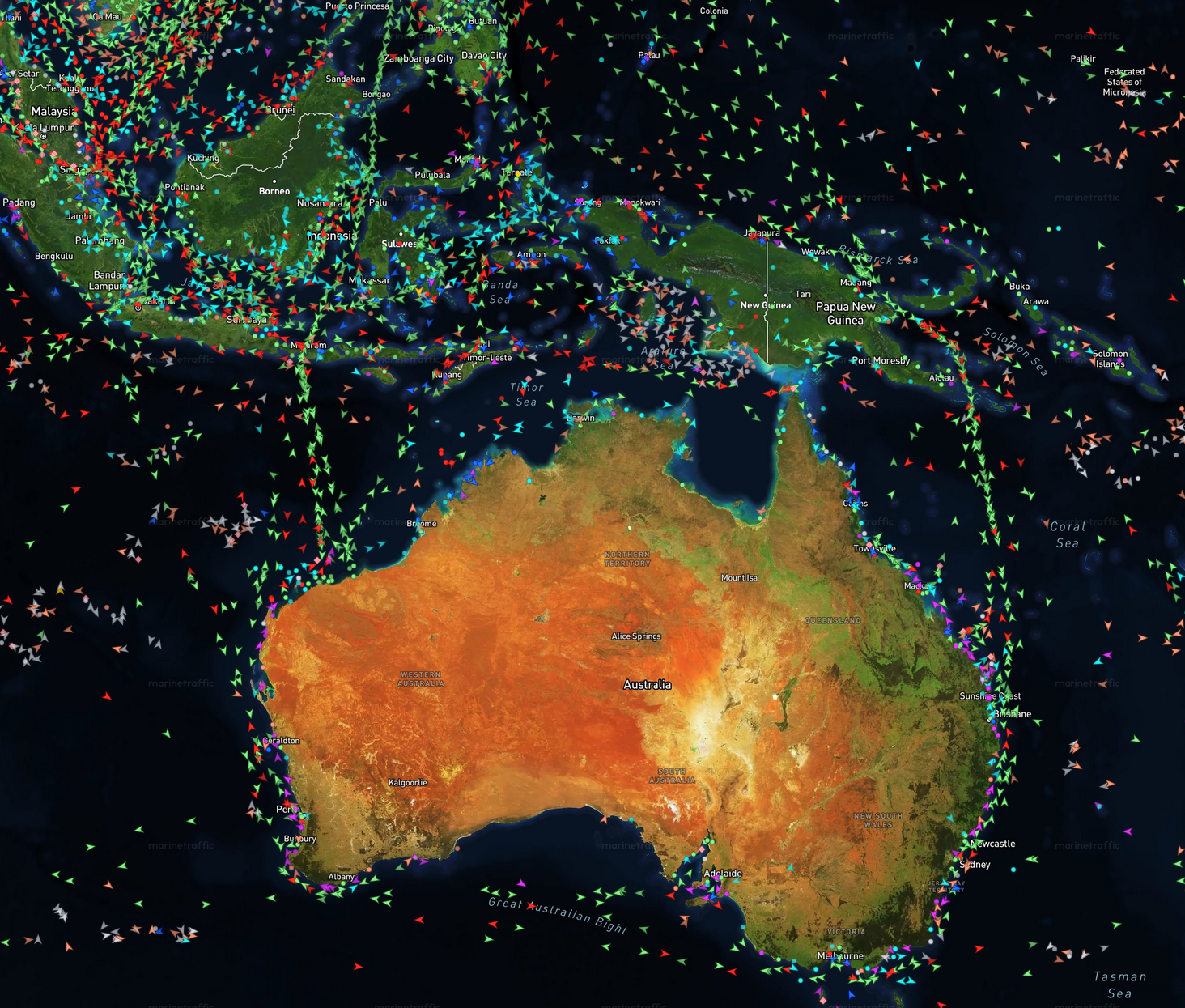
At almost any time you want you can look here, and see this constant stream of ships. It has been like this for a long time. Heres the AIS tracking link to watch these ships yourself:
Marine Traffic - AIS Ship Tracking
The importance of all this, is that when you have this much money flowing in/out of Australia, it becomes leverage. In Australian politics, society, economics and even how we percieve clearly hostile nations like China. You will see on one hand, Australia explaining how China has been a constant threat - like recent circumnavigation of Australia by Chinese warships, clearly being provocative.
The Interpreter - The Chinese warships Australians never got to debate
The Strategist - Pushed around by China, Australia is not a serious middle power
And who can forget, Syndey harbor hosting Chinese warships? Or maybe you dont know about that one.
ABC News Aus - Chinese warships arrive in Sydney
This was only in 2019, which begs the question - “What the hell!?”
And on the other hand you see the political narrative of how wonderful our relations with China are and how they are great partners:
The Guardian - Xi says Australia and China should ‘unswervingly’ work together
What was notable about the above meeting, is that Albanese had not engaged with Donald Trump at all. And through political optics, this gives the impression to all that the Chinese gov relationship is far more important than a very long standing Australian ally and partner in the USA. This is a stark contrast, compared to only a year before.
The Diplomat - Despite the Diplomatic thaw, Australians still deeply mistrust China
I think Australian citizens still hold this view, and their distrust is being manifested in distrust in their own government as well. Which I beleive is a valid view to hold considering all the evidence of influence, and control that China is applying to Australia.
Australia is moving more and more towards a socialist state, with some of the same tools the Chinese use to suppress their own peoples freedoms. I will detail this process in future articles. But here are some thoughts to ponder upon.
Australia introduced a digitial verififaction bill in late 2025:
eSafety Commissioner - Social media age restriction
Even though this supposedly targets under 16 yrs old. What does this encompass? Everyone. Because to determine if someone is under 16 yrs old you need information to confirm that. Which means all adults utilizing these sites are under the same conventions, and more importantly this is a first step in verifying and tracking all users of thes large common platforms. Think about it - is it really aimed at under 16 yr olds? or.. is it everyone.